

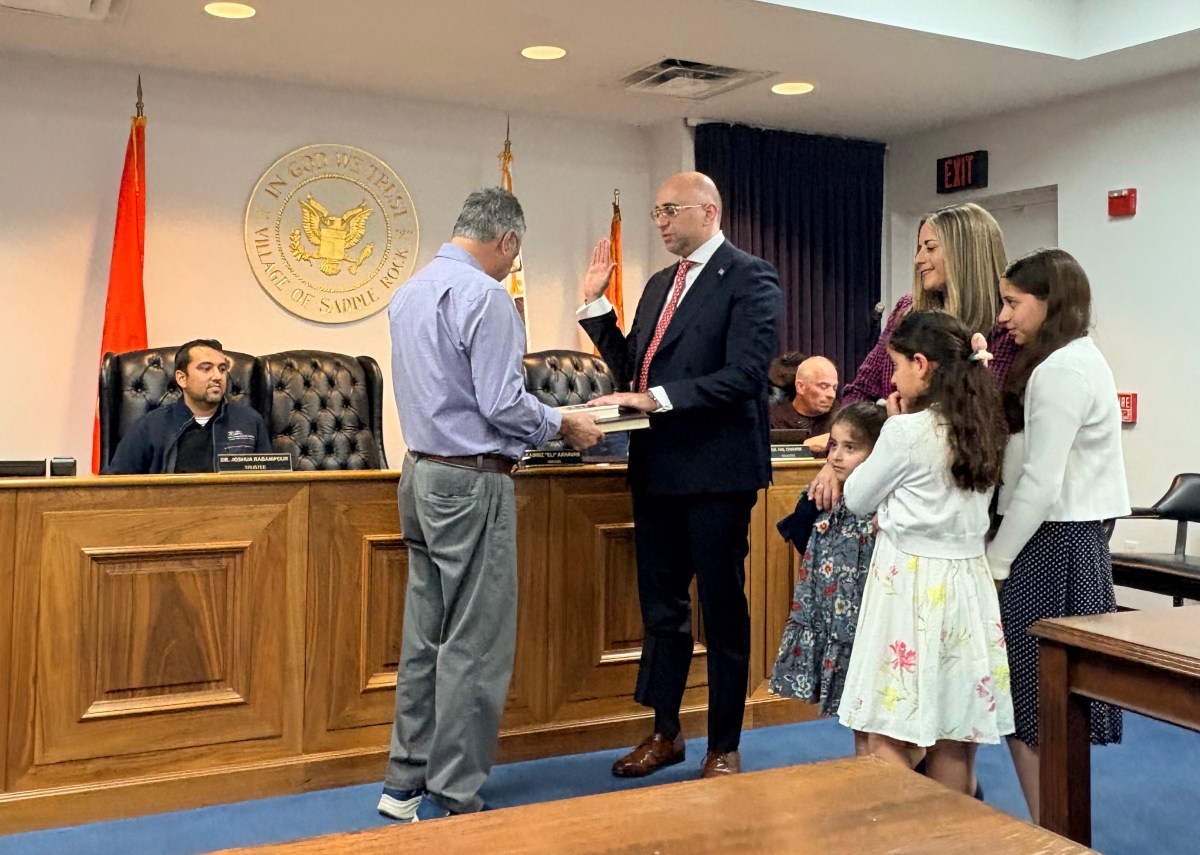





Close to 100 people packed Saddle Rock Village Hall on Wednesday, April 22, spilling into the hallway as the village’s new mayor and trustees were sworn into office following a closely watched election.
The crowd included residents, family members, and two police officers. It was the kind of turnout that small Nassau County villages rarely see at routine organizational meetings, and this one was anything but routine. The gathering opened with a review of election results that drew cheers before newly elected Mayor Kambiz “Eli” Akhavan and his trustees took their oaths.
Akhavan, a tax and estate planning attorney, began his remarks by thanking God. He called the election “historic” and framed his victory as a mandate for change, telling the crowd he was “truly honored and humbled to sit before you here as your new mayor.”
The room went quiet when he turned to his parents. They fled Iran 45 years ago carrying little beyond suitcases and a young child. Akhavan grew visibly moved.
“They came to this country to give me and their future family a better life,” he said. “The values that brought me to this moment, duty, responsibility and the commitment to doing what is right, were instilled in me by both of you.”
He also acknowledged the campaign’s cost to his family directly. “When one person in the family steps into public service, the whole family carries the burden,” he said. That line landed. Several people in the hall nodded.
Akhavan credited his brothers, including one who ran his campaign, along with his running mates and a broad coalition of supporters who believed, as he put it, in “a positive vision for our community.” The new board also took a moment to recognize former Mayor Dan Levy, who attended the ceremony and received a commemorative plaque honoring 35 years of service as both trustee and mayor. Akhavan offered the recognition without hesitation. “Anyone who steps forward to serve this community deserves recognition and appreciation,” he said.
On substance, Akhavan laid out a clear governing philosophy, one built around transparency and what he called earning public confidence through open communication. He told the room that the election had been about something larger than any single candidate. “It was about defining the government our residents want and deserve,” he said, “not about being against something, but being for something: open communication, listening carefully and making decisions in a way that earns the public’s confidence.”
Speaking with Long Island Press after the ceremony, Akhavan said he’s committed to a more transparent administration but acknowledged the new team will need time to settle into their roles. That’s a reasonable expectation for any incoming village government, though Saddle Rock residents made clear on April 22 that their patience for business-as-usual governance is limited. Ninety people crowding a Long Island village hall is not an accident.
The new mayor closed with a call for unity, drawing a firm line between the campaign period and what comes next. “We’re all neighbors,” he said. “We all care about this village and want what is best for our families, our homes and our future.”
After the board took their seats, members moved through organizational business, including the appointment of Keith Corbett to a village role.
Saddle Rock, a small incorporated village in Nassau County’s Great Neck area, doesn’t generate much regional news in a typical year. Property tax disputes, zoning questions, school board decisions in neighboring districts, those are the usual rhythms. But the election that brought Akhavan to office attracted sustained attention, and the swearing-in crowd reflected how seriously residents took the outcome.
For villages this size, transparent governance isn’t a slogan. It’s the difference between neighbors who trust each other and neighbors who sue each other. The Saddle Rock synagogue rebuild dispute, which escalated in a separate Nassau County court filing, has already shown what happens when community tensions go unresolved. Akhavan’s emphasis on open communication speaks directly to that context.
Whether the new administration delivers on that promise is a question for future meetings. What’s already on the record is that nearly 100 people showed up on a Wednesday evening in April to watch a lawyer from an immigrant family take the oath of a small-village mayoralty, and the room cheered when the election results were read aloud. In Nassau County village politics, that counts as a significant civic moment.