
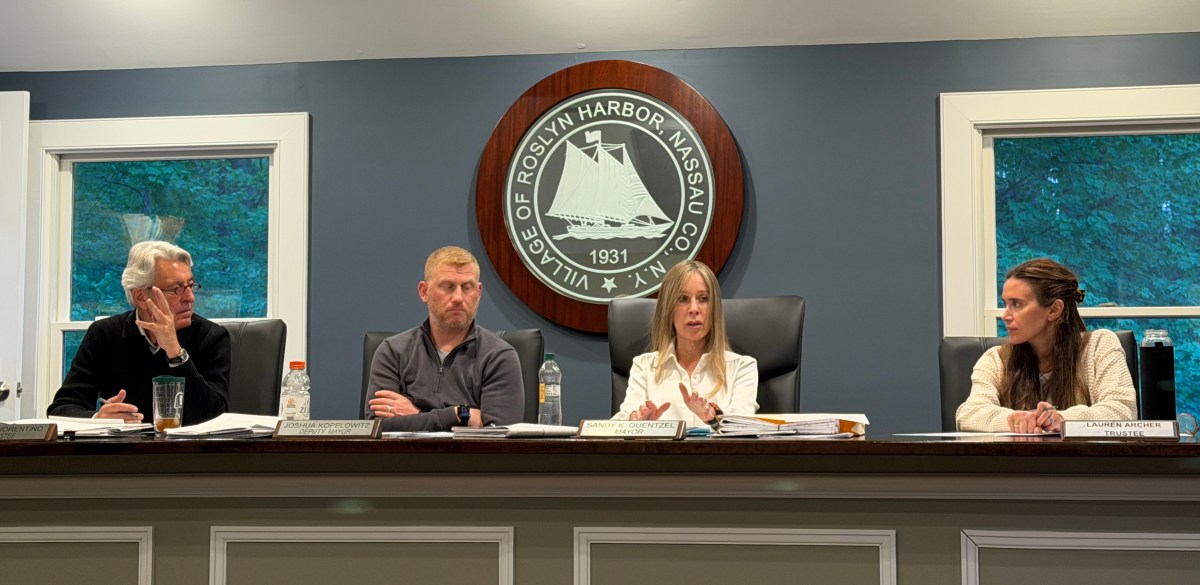







Roslyn Harbor’s Board of Trustees approved a $1,516,307.18 budget for fiscal year 2026-27 at its monthly meeting Thursday, a $39,681.29 increase over the prior year’s $1,476,625.89 spending plan.
The bump is modest by any measure. Rising costs for contracted services account for the bulk of the increase, and the property tax levy remains the village’s primary revenue source. Tax bills are expected to go out by mid-May, with payments due starting June 1.
The budget vote was one of several items the board handled at Thursday’s meeting, which also included a sports court permit, an update on a regional power transmission project, and a proposal to regulate artificial turf. It was, in short, a full night in a small Nassau County village with a lot on its plate.
The board granted a special use permit for a multi-purpose sports court at a Bryant Avenue residence. The applicant told the board the court would primarily serve her son, who has physical therapy and occupational therapy needs. The project had been revised since its initial planning board review, repositioned to the rear yard to preserve three additional trees, and buffered with three new 10-foot-tall trees along the neighboring property line. The court will sit 25 feet back from the property line and roughly 100 feet from the nearest neighboring house. Village code prohibits use before 8 a.m. or after sunset, and the court can’t drain water onto adjacent lots.
The transmission line discussion drew the most attention. Propel NY Energy, an underground transmission project that village officials said has moved closer to reality, would bring a line down Glen Cove Avenue through a portion of Roslyn Harbor before continuing onto Back Road. The route affects a small number of village residents, and it runs along roads controlled by Nassau County, not the village itself.
Mayor Sandy Quentzel made her position clear: the village can’t stop it, but it isn’t going to sit quiet during construction. “There’s people that would say otherwise. I’m not taking an opinion on that,” Quentzel said, as Long Island Press reported, referring to the broader debate over Long Island’s power grid. “I’m just saying if this is happening and the state is pushing this, we have no say, but what we do have to say is in our home rule about how our residents are treated when construction can happen.”
Quentzel added that the village intends to coordinate with Nassau County to seek road improvements and address drainage concerns tied to the project. “If this happens and the state makes this happen, I want to make sure we can make it as palatable as possible on us and our residents,” she said. Project representatives are expected to return with contractor details this summer.
It’s the kind of situation small villages find themselves in repeatedly. A state-backed infrastructure project arrives on the doorstep, the municipality has no legal authority to block it, and the best available tool is showing up and making noise. Quentzel isn’t pretending otherwise. That’s not nothing.
The board also voted to schedule a public hearing at its May 28 meeting on a proposed local law that would ban artificial turf in front yards while relaxing restrictions on its use in rear yards. The details of that proposal will get a full airing next month.
Thursday’s meeting also served as the board’s annual organizational session. New Trustee Lauren Archer was sworn in alongside incumbent Trustee James Friscia. The board approved the appointment of Maria Cerda to a village position, though the source material cuts off before her exact title is recorded. For a village with Roslyn Harbor’s scale, those appointments carry weight. The board has five members, and a single vacancy shifts the balance of any close vote.
Roslyn Harbor sits in Nassau County, incorporated as a village of roughly 1,000 residents on the North Shore, and its budget debates tend to mirror those of similar small incorporated villages across Long Island: contracted services creep up, tax levies hold the line, and the outside world occasionally sends a transmission line through the middle of things. The New York State Public Service Commission oversees projects like Propel NY Energy, and villages like Roslyn Harbor have limited standing to obstruct them, whatever their residents might prefer. The next significant public moment in this budget cycle will come in late May, when the artificial turf hearing and, presumably, further Propel NY Energy updates are both on the agenda.