

Hampton Street School in Mineola filled its hallways with foil boats, DIY lava lamps, and sail cars last week as the Nassau County district held its annual Family STEAM Night, drawing students and parents into a run of hands-on experiments that stretched well past the usual school-night bedtime.
The event isn’t a science fair. No tri-fold poster boards, no judges, no ribbons. What Mineola Public Schools built instead is something closer to a structured playground where the point isn’t the right answer but the process of getting there, which is a harder thing to teach than most school boards want to admit.
Kids moved between stations targeting each letter of the STEAM acronym: science, technology, engineering, art, and math. The Long Island Press covered the night, describing Hampton Street’s halls transformed into what organizers clearly intended as a proof-of-concept for hands-on learning pulled directly from classroom instruction.
Engineering stations were the crowd-pleasers. Students designed and tested parachutes, working out air resistance the hard way by dropping things and watching what happened. They also built sail cars, which sounds simple until you’re seven years old and your car keeps veering left because the sail isn’t centered and you can’t figure out why. That’s the lesson. Not the sail car. The figuring-out.
The buoyancy station asked families to sculpt boats from aluminum foil and then load them with weight until they sank. This is one of those deceptively elegant exercises. The engineering problem is real. Foil is cheap, failure is instant, and the feedback loop is tight enough that a kid can iterate three or four designs in 20 minutes. Archimedes worked this out around 250 B.C. in a bathtub in Syracuse. Hampton Street students worked it out on a folding table in Nassau County in April 2026, and the discovery felt equally urgent to the people making it.
Chemistry got its turn, too.
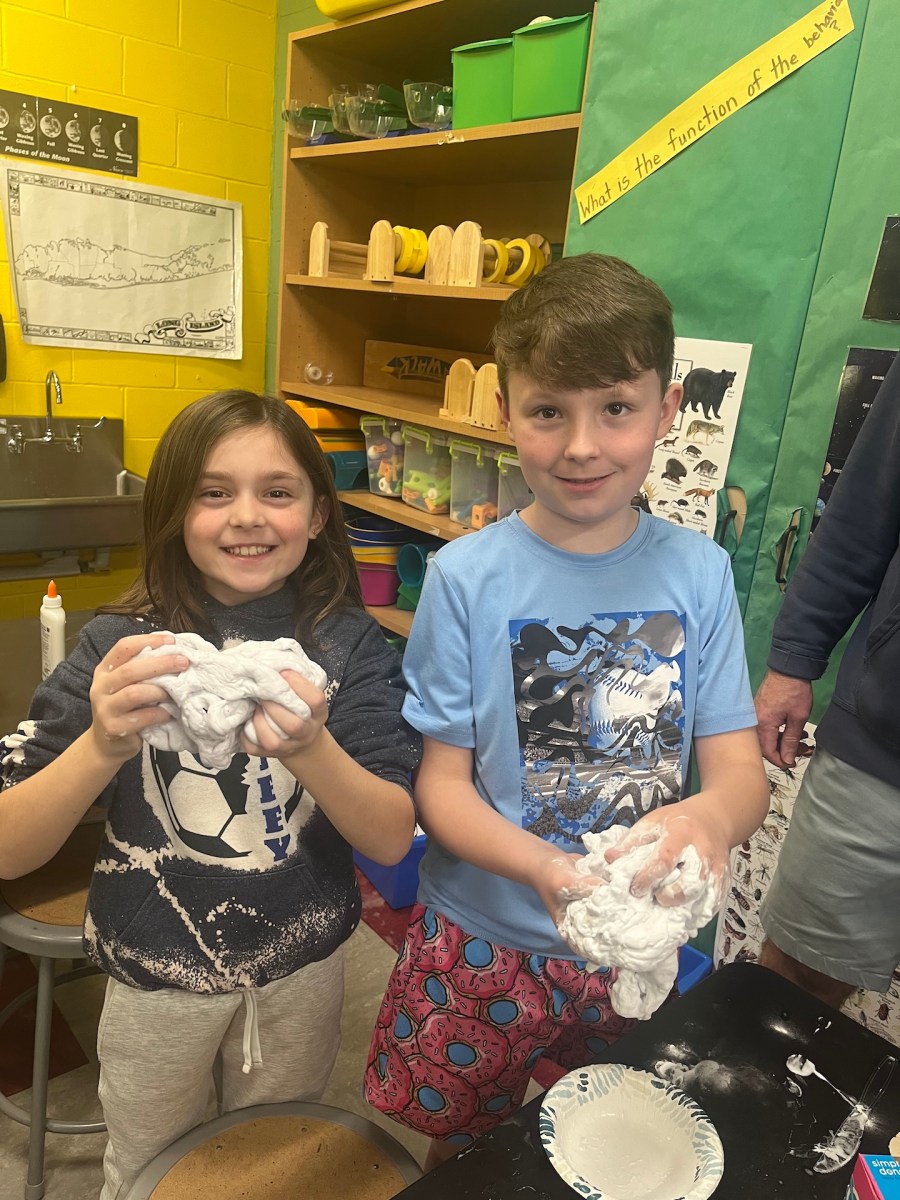
Students made lava lamps from household materials, watching density differentials push blobs of colored liquid up and down through oil. They also mixed batches of slime, which sits at the chemistry-art border and has reliably delighted children since the 1970s. Both experiments are low-cost, high-engagement, and connected to real scientific principles that show up in New York State’s Next Generation Science Standards, the framework adopted to push K-12 science education toward exactly this kind of inquiry-based work.
What Mineola is doing at Hampton Street reflects a broader push in New York districts to get STEM concepts off the worksheet and into students’ hands. The National Science Teaching Association has documented for years that inquiry-based learning improves both retention and student confidence in science subjects, particularly among younger learners who haven’t yet decided that math is “not for them.” Family nights like this one serve a secondary purpose that doesn’t always get acknowledged: they put parents in the room. A parent who watches their kid troubleshoot a collapsing foil boat at 7 p.m. on a Tuesday is more likely to reinforce that kind of thinking at home. That’s not a small thing.
The school made explicit that “trial and error” was the event’s organizing philosophy. Whether a project worked on the first try or required a full redesign, the emphasis stayed on the process, not the outcome. That’s easy to say in a press release and harder to execute in a gymnasium where parents are watching and kids are competitive. The faculty and volunteers who staffed the stations deserved credit for holding that line.
Mineola Public Schools acknowledged those staffers directly, extending what the district called its gratitude to the faculty, staff, and volunteers whose work made the night possible.
Hampton Street is a public elementary school drawing from one of Nassau County’s more established suburban communities. Mineola’s median household property tax burden runs high even by Long Island standards, and residents who write those checks tend to pay attention to what the district is actually producing in its classrooms. An event like Family STEAM Night doesn’t answer every question about educational outcomes, but it does something useful: it puts the learning in front of the taxpayers funding it, in a building they own, on a weeknight when they could have been anywhere else. The families who showed up got to see the work. That kind of transparency belongs at every school on the island, not just one on Hampton Street.